A Journey Through the Warriors: Myth, Strength and Finding Your Posture
Warrior poses are familiar shapes in yoga: feet grounded, arms reaching, attention focused. Yet behind these postures is a dramatic story, and within their practice is an opportunity to explore much more than how far we can stretch.
In this term’s journey through the warriors, we will explore courage, attention, balance, humility and peace. We will also continue a thread we have been working with throughout the year: finding the strength and balance within a posture alongside the stretch.
Rather than simply moving into a shape, we can begin to discover what supports us there. Where do we need to engage? Where might we soften? What changes when we feel steady enough to breathe?
The myth behind the warriors
The warrior poses take their name from Virabhadra, a fierce warrior associated with the Hindu deity Shiva. Virabhadrasana means the posture of Virabhadra.
Like many stories carried through religious texts, traditions and oral retellings, this myth has different versions. What follows is one outline of the story, not a definitive account. Details, emphases and interpretations vary. The narrative includes death and violence, which are part of its background rather than instructions for how to live or practise.
Shiva is married to Sati, whose father, Daksha, disapproves of him. Daksha holds a great ritual sacrifice, but excludes Shiva. Sati goes to the gathering, where she encounters her father’s hostility and the deliberate dishonouring of her husband.
Overcome by anger and sorrow, Sati relinquishes her body through yogic fire. This is a tragic moment in the narrative.
When Shiva hears of her death, he is consumed by grief and fury. He tears a strand of hair from his head and casts it to the ground. From it emerges Virabhadra, a formidable embodiment of his anger.
Shiva sends Virabhadra to Daksha’s ceremony. The warrior and Shiva’s followers devastate the gathering, and Virabhadra beheads Daksha.
The story eventually turns towards reconciliation. Shiva agrees to Daksha’s restoration; because his original head has been destroyed, he is brought back to life with the head of a goat. Daksha recognises his wrongdoing, and the sacrifice resumes. [1–3]
This is a more complicated story than a simple celebration of bravery. It contains love, exclusion, pride, grief, destructive anger and the possibility of repair.
From an ancient story to modern postures
Although the myth is ancient, the warrior poses familiar in classes today belong to modern postural yoga. Warriors I, II and III appear in twentieth-century teaching, including B. K. S. Iyengar’s Light on Yoga. We should distinguish the age of the story from the documented history of the physical poses. [4]
In a popular contemporary yoga retelling, Warrior I represents Virabhadra rising or arriving with weapons raised; Warrior II represents identifying his opponent and preparing to act; and Warrior III represents his decisive movement forwards. These connections vary between teachers. They are ways of interpreting the shapes through the story, rather than an asana sequence prescribed by the ancient narrative. [5]
Humble Warrior and Reverse, or Peaceful, Warrior are commonly taught variations. In this journey, their themes of humility and peace are reflections we bring to the practice—not claims that they depict two further scenes specified in the original text.
We can respect the story’s Hindu origins while being clear about where our modern teaching interpretation begins.
Finding strength alongside the stretch
It is easy to think of yoga as stretching: reaching further, sinking lower or making a larger shape. But a posture also asks us to organise our weight, use muscular effort and respond to movement.
In the warriors, the legs and hips help support us, the trunk helps manage the position of the body, and the arms add another demand. Even when we appear still, small adjustments continue.
The stretch is one part of the experience. Strength helps us support and control the position; balance asks us to notice where our weight is and adapt. Together, they help us find a version of the posture that feels purposeful and manageable.
That may mean shortening a stance, bending a knee less, lowering the arms or using a wall or chair. A smaller shape can reveal more about the posture if it allows us to feel both the work and the breath.
Finding our posture is an ongoing conversation with the body. It means exploring how our own proportions, mobility, strength and energy come together today. That experience may also help us notice how we stand and move away from the mat, without suggesting there is one perfect position we should hold all day.
Warrior I: courage and foundations
Virabhadrasana I
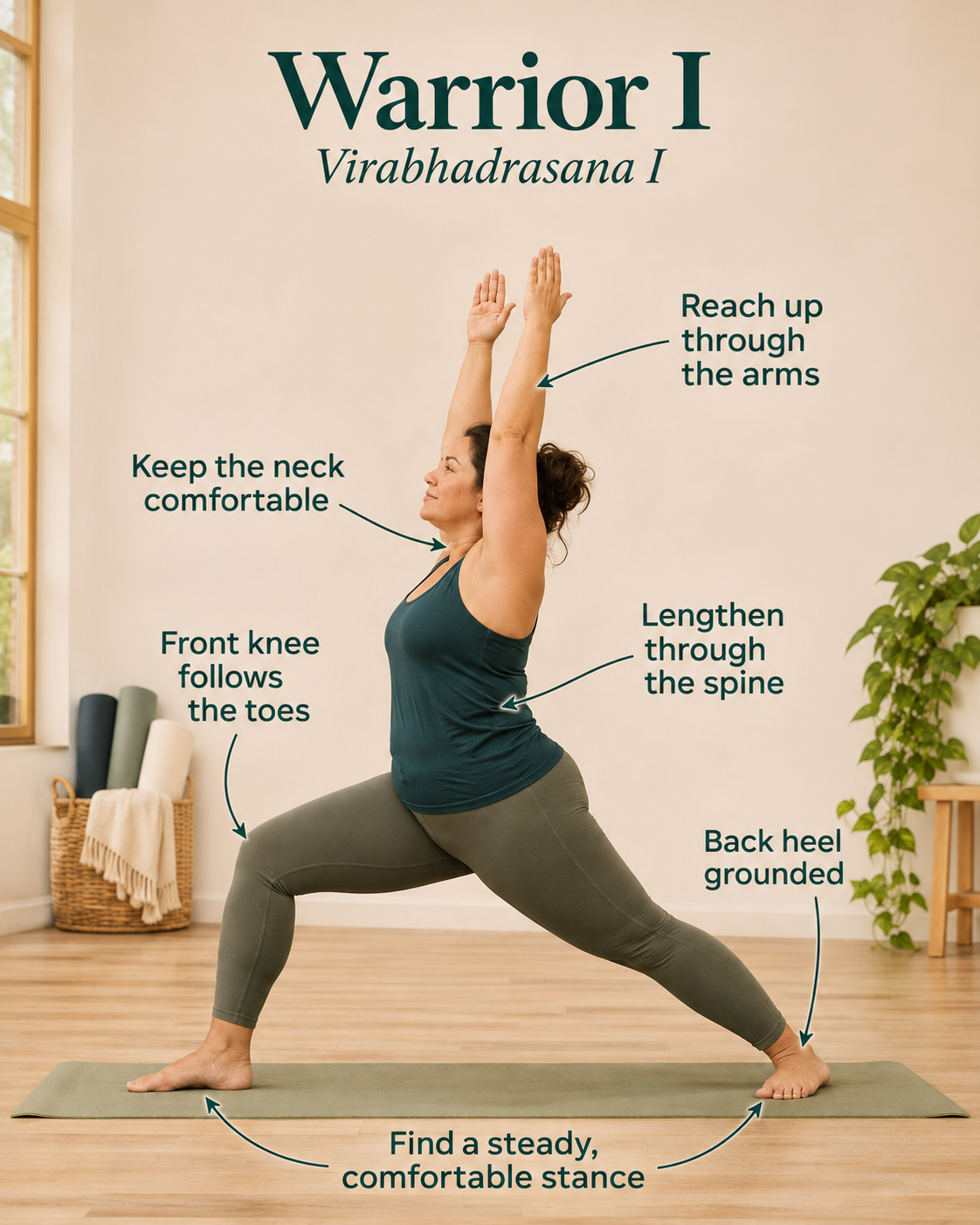
With the arms rising and the feet grounded, Warrior I offers an image of gathering ourselves and stepping forwards. For our practice, its theme is courage supported by a foundation.
The front leg works as the knee bends, while the back leg contributes support. Raising the arms changes the demand on the shoulders and trunk. We may feel a stretch around the front of the back hip or calf, depending on our stance and anatomy.
Instead of chasing a deeper lunge or forcing the pelvis to face exactly forwards, we can explore a stance that allows the legs to work and the upper body to rise comfortably. The feet can be wider apart from side to side if that helps us feel stable.
Courage here might mean trying something unfamiliar. It can also mean choosing the support that makes the posture work for us.
Reflection: Can I feel grounded as I rise?

Warrior II: discernment and attention
Virabhadrasana II
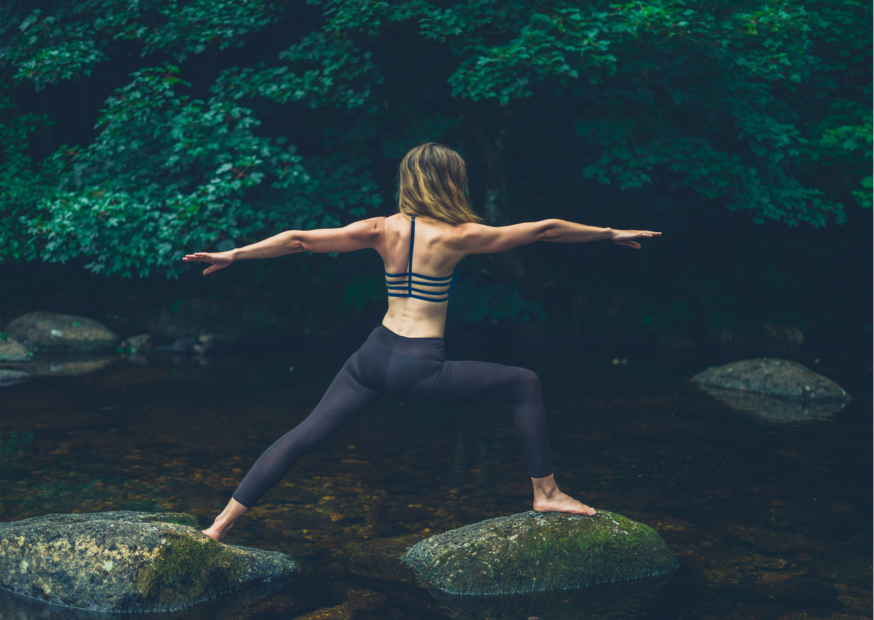
Warrior II has a clear direction: the front knee bends, the arms extend and the gaze usually follows the front hand. We can use this shape to explore where we place our attention and how we direct our energy.
The legs support the stance while the trunk remains upright. There may be a sense of opening through the hips and inner thighs, alongside the effort of maintaining the position.
We can notice whether we have leaned towards the front hand, tightened the jaw or lifted the shoulders as the legs begin to work. Finding the posture may involve redistributing effort: keeping useful engagement in the legs while allowing the face and breath to soften.
The deeper lunge is not automatically the more attentive practice. Our task is to notice how much effort we can sustain with awareness.
Reflection: Where am I directing my energy?
Warrior III: balance and adaptability
Virabhadrasana III
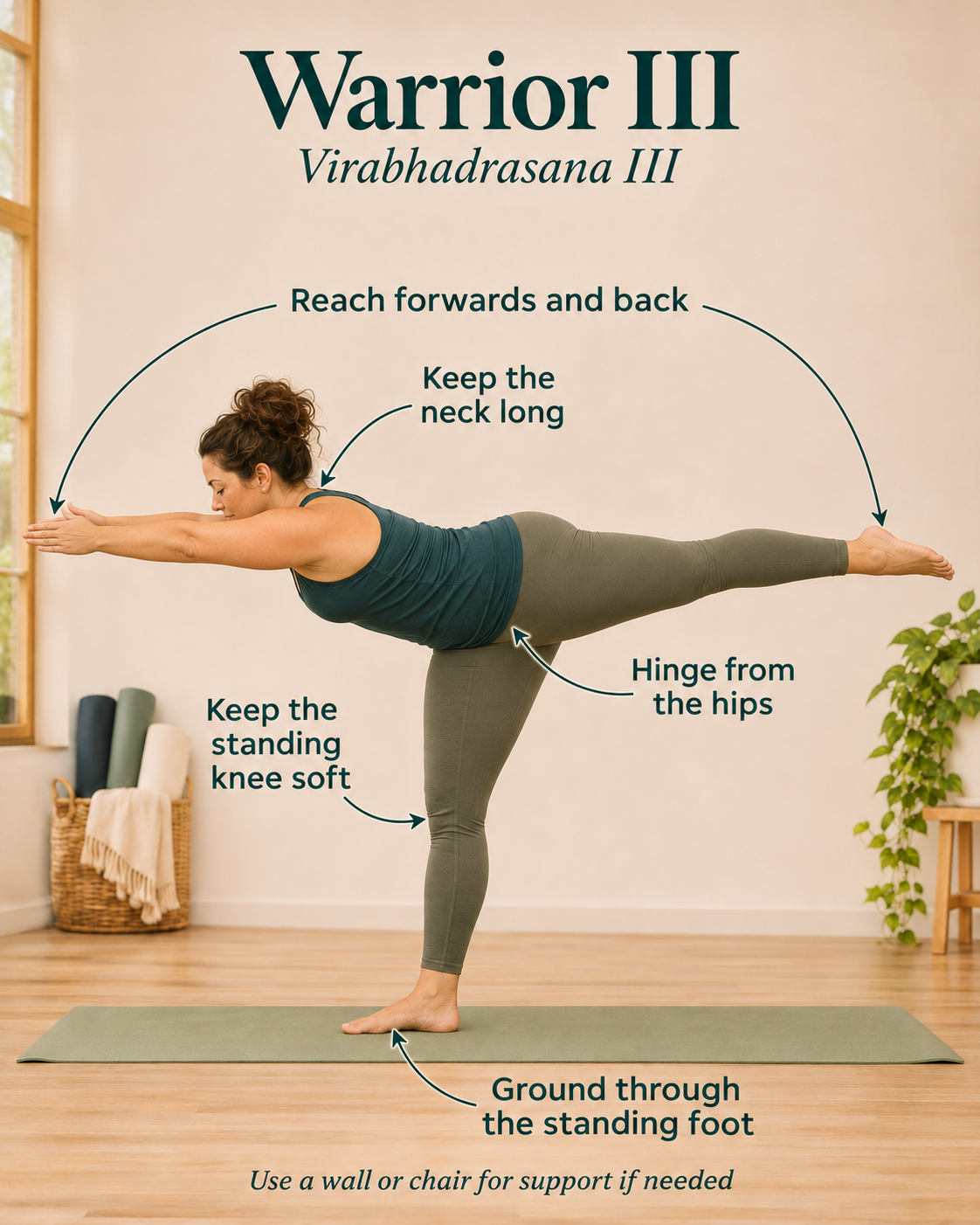
As we shift onto one leg and reach the other leg behind us, Warrior III makes the relationship between strength and balance particularly clear.
The standing foot, ankle and hip make continual adjustments. The trunk helps support the forward-reaching torso, while the lifted leg creates a counterbalance. A stretch may be felt through the back of the standing leg, but reaching further is only one small part of the pose.
We can practise with hands on a chair or wall, keep the back toes on the floor, or lift the back leg just a little. The torso does not need to become parallel with the floor for the exploration to be valuable.
Wobbling gives us information. It invites us to adjust the position, change our focus or accept some support. Balance is something we keep finding.
Reflection: Can I adjust without judging myself?

Humble Warrior: strength that can yield
Often called Baddha Virabhadrasana or Devotional Warrior
Humble Warrior brings a bowing movement into the warrior family. It offers a way to explore humility: listening closely enough to recognise what is appropriate for us.
As the torso folds, the legs continue to support the body. The change in weight challenges balance, while the position may bring a stretch through the shoulders or hips, depending on the variation.
Clasping the hands behind the back is optional. We can use a strap, keep the hands on the hips, or place them on a chair. The fold can remain small.
Humility in practice might mean releasing an expectation, changing a familiar version or recognising that today we need something different. Strength gives us the support to yield with awareness.
Reflection: Can strength include yielding?
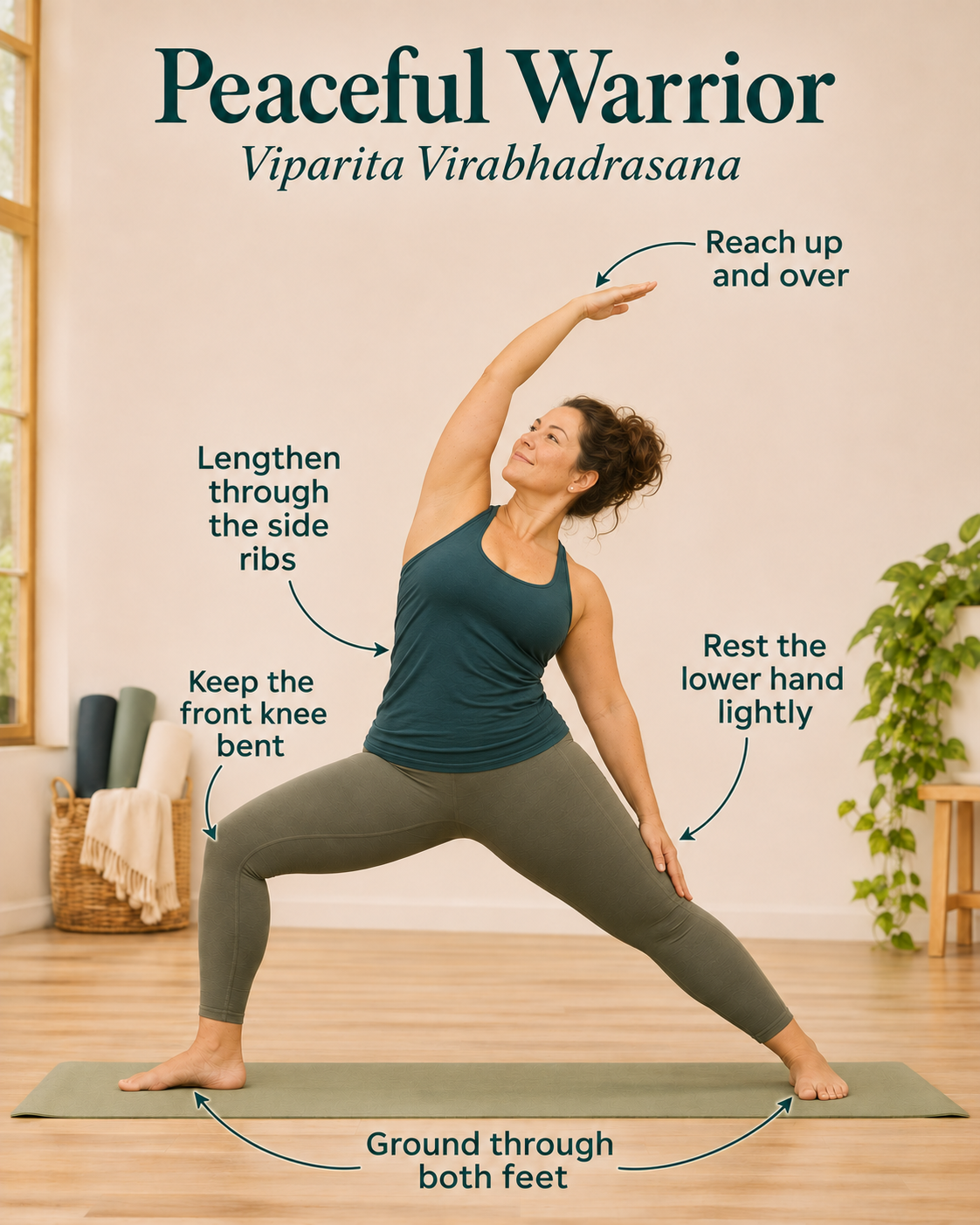
Peaceful Warrior: strength with spaciousness
Also called Reverse Warrior; commonly Viparita Virabhadrasana
From Warrior II legs, the front arm reaches upwards and back, creating length through the side of the body. Some teachers use names such as Sun Warrior for a similar shape.
For our journey, this posture brings together steadiness, openness and compassion. Peace becomes something we explore while effort is still present.
The legs continue to support the stance as the upper body moves. Rather than sinking into the lower back or placing weight through the lower hand, we can explore length through the side ribs and a comfortable reach. The upper hand can stay on the hip, and the gaze can remain forwards or down.
The stretch may become more useful when we have enough support to approach it gradually. We can keep the foundation while making the movement smaller and the breathing easier.
Reflection: Can I remain strong while softening my effort?
Learning what to do with our strength
One philosophical thread running through this journey is the question of how we use strength.
The myth shows power expressed through anger, with devastating consequences. Its eventual movement towards restoration gives us a way to reflect on responsibility, compassion and repair. This is one possible reading of a complex religious narrative, rather than its only meaning.
On the mat, we might notice the difference between determination that sustains our attention and determination that pushes past what feels appropriate. We can be committed to learning while remaining willing to change our approach.
Strength can help us hold a boundary, remain present with a challenge, or step back when we need to. Each warrior gives us a different place to explore that choice.
Ahimsa: bringing care into the effort
The second thread is ahimsa, commonly translated as non-harming or non-violence. Within yoga philosophy, it is one of the yamas described in Patanjali’s Yoga Sutras.
For our physical practice, we can bring this principle into the way we respond to ourselves. Can we recognise effort without treating discomfort as a test of worth? Can we explore a stretch without forcing it? Can we accept support without deciding that we have achieved less?
Ahimsa leaves room for challenge. It invites us to approach that challenge with care.
The warriors can therefore become a practice of strength guided by attention: grounded enough to explore, adaptable enough to change, and kind enough to listen.
Finding your own warrior
Across the term, we will revisit these shapes so there is time to become familiar with them, explore different options and notice what changes.
Some days the discovery may be in the legs working more clearly. On another day, it may be a steadier balance, a less ambitious reach, or the realisation that a prop allows more freedom to breathe.
As strength, balance and stretch begin to work together, we can find a posture that feels more fully our own and consider how courage, discernment, adaptability, humility and peace might accompany us beyond the mat.
Covered in this blog
- The Hindu myth behind the warrior poses.
- How the ancient story connects with modern yoga practice.
- A theme for each of the five warriors.
- Learning what to do with our strength, and practising ahimsa.
- How strength, balance and stretch help us find our own posture.
Sources and further reading
1. Bhagavata Purana, Canto 4, Chapter 4: Sati Quits Her Body. One translated textual account; wording and interpretation vary between traditions and translations.
2. Bhagavata Purana, Canto 4, Chapter 5: Frustration of the Sacrifice of Daksha.
3. Bhagavata Purana, Canto 4, Chapter 7: The Sacrifice Performed by Daksha.
4. B. K. S. Iyengar, Light on Yoga (1966), entries for Virabhadrasana I, II and III. See also Yoga Journal, Ways of the Warrior, on the poses’ modern history and variation across teaching traditions.
5. Seattle Yoga News, A Study of the Warrior Yoga Poses, an example of modern pose-to-story associations; and Yoga International, Stand Strong in Your True Self, for a contemporary philosophical interpretation.
6. Patanjali, Yoga Sutras, II.30 and II.35, for ahimsa. The posture themes and practical reflections in this article are my teaching interpretations.