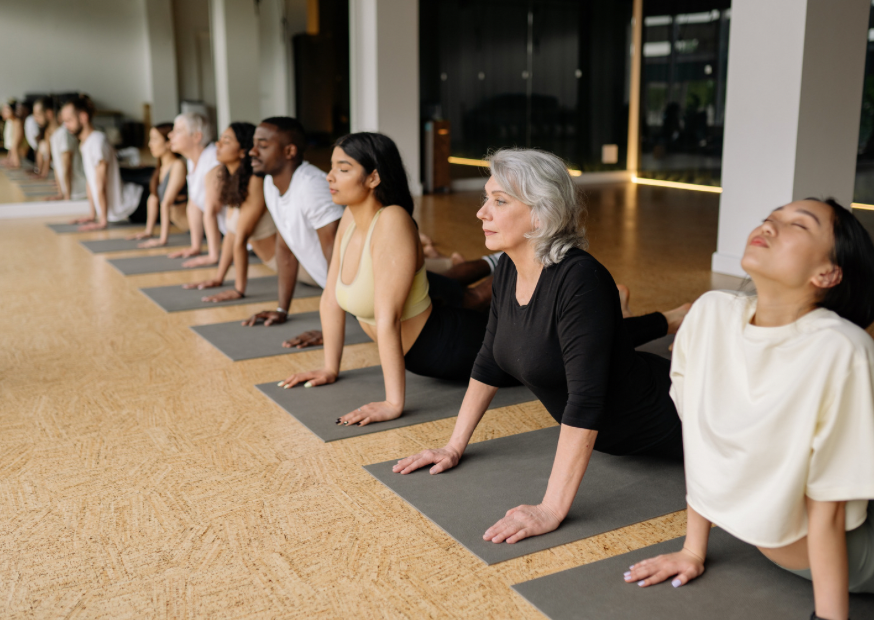
When can you safely return to your yoga practice after an operation?
If yoga was part of your normal routine before surgery, you may be keen to get back to your mat as quickly as possible.
But surgery places significant demands on the body.
Even when the operation itself has gone well, your body needs time and energy for:
- Wound healing
- Tissue repair
- Recovery from anaesthetic
- Managing inflammation
- Rebuilding strength
- Restoring mobility
- Recovering normal energy levels
The NHS notes that significant tiredness can be normal after an operation, particularly following major surgery or general anaesthetic, while also encouraging people to start moving as soon as appropriate and follow their doctor’s advice about becoming active again. (nhs.uk)
Returning to yoga therefore isn’t simply a question of:
“How many weeks has it been?”
It is:
“What operation did I have, what tissues are healing, and what movements and loads am I currently allowed to perform?”
Surgery is not one thing
There is no universal “yoga after surgery” timetable.
Consider the difference between recovering from:
- Abdominal surgery
- Keyhole surgery
- Heart surgery
- Joint replacement
- Spinal surgery
- Hernia repair
- Breast surgery
- Gynaecological surgery
- Orthopaedic surgery
- Eye surgery
The restrictions can be completely different.
This is why advice such as:
“Wait six weeks before doing yoga”
is too simplistic.
Your surgeon’s restrictions and rehabilitation plan take priority.
Why movement after surgery matters
Rest is important.
But prolonged inactivity has its own consequences.
Depending on your operation, appropriate early movement can help with circulation and gradually rebuild strength.
The NHS encourages people to move around as soon as appropriate after surgery and to follow their medical team’s advice about becoming active again. (nhs.uk)
Initially, movement might simply mean:
- Getting out of bed
- Walking around the house
- Short walks
- Breathing exercises
- Prescribed physiotherapy
That is exercise during early recovery.
You don’t need to rush into yoga poses to be actively rehabilitating yourself.
Healing isn’t the same as feeling better
One of the difficulties with returning to exercise is that you may start feeling significantly better before all the tissues involved in surgery have fully healed.
Pain may decrease.
Your energy may return.
You may become bored with your restrictions.
But that doesn’t necessarily mean your body is ready for:
- Deep stretches
- Planks
- Strong twists
- Backbends
- Long holds
- Repeated Sun Salutations
- Inversions
- Strong abdominal work
Follow your postoperative restrictions even when you feel capable of doing more.
Your wound matters
Yoga can place tension through tissues in ways that aren’t always obvious.
For example, after abdominal surgery:
- A backbend stretches the front of the abdomen
- A twist creates rotational forces
- Plank increases abdominal demand
- Getting from the floor to standing can require substantial core effort
After breast or chest surgery, weight-bearing and large shoulder movements may pull through healing tissues.
After orthopaedic surgery, a particular joint may have specific movement or loading restrictions.
So don’t judge a yoga pose simply by whether it feels gentle.
Think about what tissues the movement is loading.
Abdominal surgery
Following abdominal surgery, you may temporarily need to modify:
- Plank
- Boat Pose
- Strong abdominal exercises
- Deep twists
- Large backbends
- Strong transitions
- Getting up from the floor
Initially, walking and prescribed rehabilitation may be more appropriate.
Gradually rebuild abdominal loading according to the guidance from your surgical or physiotherapy team.
Heart surgery
Heart surgery may involve additional cardiovascular and surgical considerations.
Following some operations, particularly those involving the sternum, there may initially be restrictions around upper-body loading and movement.
Cardiac rehabilitation can play an important role in returning to exercise safely.
See my separate guide:
Yoga & Heart Conditions: What You Need to Know
for more detail.
Joint replacement surgery
Hip, knee and shoulder replacements all have different considerations.
You may need to adapt:
- Hip range of movement
- Kneeling
- Deep knee flexion
- Upper-body weight-bearing
- Balance
- Floor transfers
See my separate guide:
Joint Replacements & Yoga: What You Need to Know
for more detailed information.
Spinal surgery
Returning to yoga after spinal surgery requires individual guidance.
Depending on the operation, you may temporarily or permanently have restrictions involving:
- Flexion
- Extension
- Rotation
- Loading
- Lifting
Do not assume that because yoga is “gentle” every spinal movement is appropriate.
Follow your surgeon or physiotherapist’s guidance.
Eye surgery
Certain eye operations can involve very specific restrictions around:
- Bending forwards
- Lifting
- Straining
- Inverted positions
If you’ve recently had eye surgery, ask your ophthalmology team when these movements can safely be resumed.
Don’t assume that a head-down yoga posture is harmless because it doesn’t feel strenuous.
Pelvic and gynaecological surgery
Operations involving the pelvis, abdomen or pelvic floor may require a gradual return to:
- Abdominal loading
- Lifting
- Strong standing work
- Deep stretching
- High-pressure activities
Your postoperative rehabilitation guidance should determine your progression.
Gentle breathing and mobility may return before strenuous yoga.
What about scar tissue?
Once a surgical wound has healed, you may notice:
- Tightness
- Altered sensation
- Numbness
- Sensitivity
- Changes in movement around the scar
This doesn’t automatically mean that you should aggressively stretch the area.
Depending on the surgery, scar management or mobilisation may be appropriate, but this should follow advice from your healthcare professional where necessary.
Give tissues time to heal before trying to “release” them.
Fatigue after surgery
Don’t underestimate postoperative fatigue.
Your body is using energy to heal.
Sleep may have been disrupted.
You may have lost fitness and strength.
Medication can also contribute to fatigue.
So your first yoga session may feel considerably harder than you expect.
That doesn’t mean you’ve failed to recover.
Start with less than you think you can do and see how your body responds later that day and the following day.
Returning to yoga in stages
Rather than going directly from recovery to your normal class, consider a staged return.
Stage 1 – Recovery
Your priorities may simply be:
- Rest
- Walking
- Breathing
- Prescribed rehabilitation
- Gentle daily movement
Stage 2 – Gentle yoga-based movement
Once cleared:
- Comfortable mobility
- Supported standing
- Gentle balance
- Breathing
- Relaxation
Stage 3 – Rebuilding strength
Gradually introduce:
- Standing poses
- Appropriate resistance
- Longer periods of movement
- Controlled transitions
Stage 4 – Reintroducing specific poses
Gradually bring back movements that require:
- Greater range
- More load
- Floor transfers
- Weight-bearing
- Balance
Stage 5 – Return to your wider practice
You may eventually return to most or all of your previous practice.
Or you may discover that some poses are better permanently modified.
Both outcomes can still represent a successful recovery.
What about restorative yoga?
It is easy to assume that restorative yoga is automatically safe after surgery.
Often it can be a lovely part of recovery.
But restorative postures still place the body in particular positions.
A bolster-supported backbend, for example, may stretch an abdominal or chest incision.
A deeply supported twist still involves rotation.
A low floor position may be difficult to get into and out of.
So restorative yoga should still be adapted to the operation.
Sometimes the simplest option is:
comfortable supported rest + breathing + relaxation.
Getting onto and off the floor
This is frequently overlooked.
You may be perfectly comfortable once lying on your yoga mat but struggle to get back up without:
- Straining
- Holding your breath
- Pulling on furniture
- Loading a healing joint
- Putting pressure through an incision
A chair-based or predominantly standing practice may therefore be more appropriate initially.
Yoga doesn’t have to happen on the floor.
When might 1-to-1 yoga be useful?
Returning directly to a group class can feel daunting after surgery.
A private session gives you an opportunity to work through:
- Your medical restrictions
- Getting up and down
- Appropriate props
- Which poses need modifying
- How much movement feels appropriate
- Alternatives to weight-bearing
- Balance
- Breathing
- Relaxation
You can then take those modifications into a group class.
What should I tell my yoga teacher?
Tell your teacher:
- What operation you had
- Approximately when you had it
- Whether you are still under medical or physiotherapy care
- Any movement restrictions
- Any weight-bearing restrictions
- Whether your wound has healed
- Any movements you’ve specifically been told to avoid
- Whether you have difficulty getting onto the floor
- Whether balance is affected
- Whether you fatigue easily
Your teacher doesn’t need every medical detail.
But “I’ve recently had surgery” is important information.
When should I stop and seek advice?
Don’t continue exercising through:
- Significant or increasing pain
- New wound pain
- Wound opening
- Bleeding or discharge
- Increasing redness or swelling
- Fever or feeling acutely unwell
- Chest pain
- Significant breathlessness
- Feeling faint
- New neurological symptoms
- Sudden loss of function
Contact the appropriate healthcare service according to the symptoms and their severity.
Practical tips for returning to yoga after surgery
1. Ask your surgeon when you can return to exercise.
2. Ask about movements, not just “yoga”.
Your surgeon may understand “lifting, twisting, bending and weight-bearing” more clearly than the demands of a particular yoga style.
3. Follow your rehabilitation programme.
4. Start gently.
5. Don’t assume feeling better means completely healed.
6. Respect lifting and weight-bearing restrictions.
7. Consider what tissues each pose loads.
8. Don’t force scarred or healing tissues into a stretch.
9. Use props.
10. Consider a chair-based practice initially.
11. Allow for postoperative fatigue.
12. Notice how you feel later that day and the following day.
13. Tell your yoga teacher.
14. Consider a 1-to-1 session before returning to a group class.
15. Remember that returning gradually isn’t going backwards.
Summery
Surgery doesn’t necessarily mean the end of your yoga practice.
But recovery isn’t a race back to your mat.
The NHS encourages people to begin moving again as soon as appropriate after surgery while following their doctor’s advice about activity and exercise. (nhs.uk)
Initially, that movement may be walking and rehabilitation rather than yoga.
As healing progresses, yoga may gradually provide opportunities to rebuild:
- Strength
- Mobility
- Balance
- Body awareness
- Confidence
- Relaxation
The important thing is that your yoga practice adapts to your recovery — not that your recovery adapts to your yoga practice.
Some poses may return quickly.
Some may take considerably longer.
And occasionally a pose may need to be permanently adapted.
A successful return to yoga isn’t measured by how quickly you get back into your deepest forward fold, strongest Plank or fullest backbend.
It is measured by whether movement is once again helping you feel stronger, more capable and more confident in your body.
Frequently Asked Questions
How soon after surgery can I return to yoga?
There is no universal timeframe. It depends on the operation, healing, complications and the movements involved in your yoga practice. Ask your surgical team about your specific activity restrictions.
Can I do gentle yoga soon after surgery?
Possibly, but “gentle” isn’t specific enough. A seemingly gentle twist, forward bend or restorative posture may still load healing tissues. Ask what movements are currently permitted.
Can I do restorative yoga after surgery?
Often eventually, but individual poses may need modification. Supported rest and comfortable breathing may be appropriate before more complex restorative positions.
Why am I still tired after surgery?
Postoperative fatigue is common, particularly following major surgery or general anaesthetic. The NHS advises doing only as much as you feel able while gradually returning to normal activity. (nhs.uk)
Should I tell my yoga teacher I’ve had surgery?
Yes. Tell them what type of surgery you had and any restrictions you’ve been given.
Would private yoga be better before returning to class?
It can be particularly useful if you have multiple restrictions or are uncertain about how to modify your previous practice.
References
- NHS. Having an operation (surgery): getting back to normal. Guidance on postoperative fatigue, movement, wound healing and gradually returning to normal activity. (nhs.uk)
- NICE. Rehabilitation after traumatic injury (NG211). Principles of rehabilitation, goal setting and individualised recovery following injury. (Nice)
Topics Covered in This Article
- Yoga after surgery
- Returning to exercise
- Healing after an operation
- Postoperative fatigue
- Wound healing
- Abdominal surgery
- Heart surgery
- Joint replacement
- Spinal surgery
- Eye surgery
- Pelvic and gynaecological surgery
- Scar tissue
- Weight-bearing restrictions
- Restorative yoga after surgery
- Getting onto and off the floor
- Gradual return to yoga
- Using yoga props
- 1-to-1 yoga
- Talking to your yoga teacher
- When to stop exercising
- When to seek medical advice
Please note: This article provides general educational information and isn’t intended to replace the postoperative instructions provided by your surgeon, doctor, physiotherapist or other healthcare professional. Operations vary considerably, and your individual surgical restrictions should always take priority over general yoga guidance.

Yoga classes in Exeter, book here
My yoga classes run in themes for five weeks. This allows for people to put in place adaptions to suit their body and learn the different options of each yoga flow that are right for them. After the five weeks you will find each yoga flow published on my blog, with a free interactive copy. You will find the yoga class for this theme below.
Want to try one of my yoga classes?
I run yoga classes in Exeter- Exminster & Topsham, Devon
My Exeter based yoga classes are suitable for most levels of yogis. There are flowing sequences, often using sun salutations and vinyasa to warm the body and move through the yoga postures.
The yoga classes include an element of all styles of yoga, to bring a fresh angle to yoga and will encourage the use of yoga props in a fun and informal environment to help you explore your practice. My styles include Hatha Yoga, Vinyasa Yoga, Flow Yoga, Yin Yoga & Restorative Yoga.
Variations to yoga postures will be given throughout the class allowing each person to adapt the class to their personal level of yoga practice. All equipment is provided.
Classes are available at Kiva & Zen Studios in Topsham, Exeter, Victory Hall in Exminster, Exeter.
Book a yoga class today and immerse yourself in the tranquil atmosphere of my Exeter yoga venues, while rejuvenating your mind and body through the practice of yoga.
Each session is designed to help you connect with your inner self, cultivate mindfulness, and improve flexibility, strength, and balance. Whether you're a beginner to yoga or an experienced practitioner, there's a class for you in my Exeter venues.
As a Yoga Teacher, I underwent my initial yoga training in India and am both qualified and registered with the Yoga Alliance. Since completing my initial yoga qualification, I have undertaken further yoga studies both here in Exeter and in locations around Europe.
Book your yoga classes in Exeter