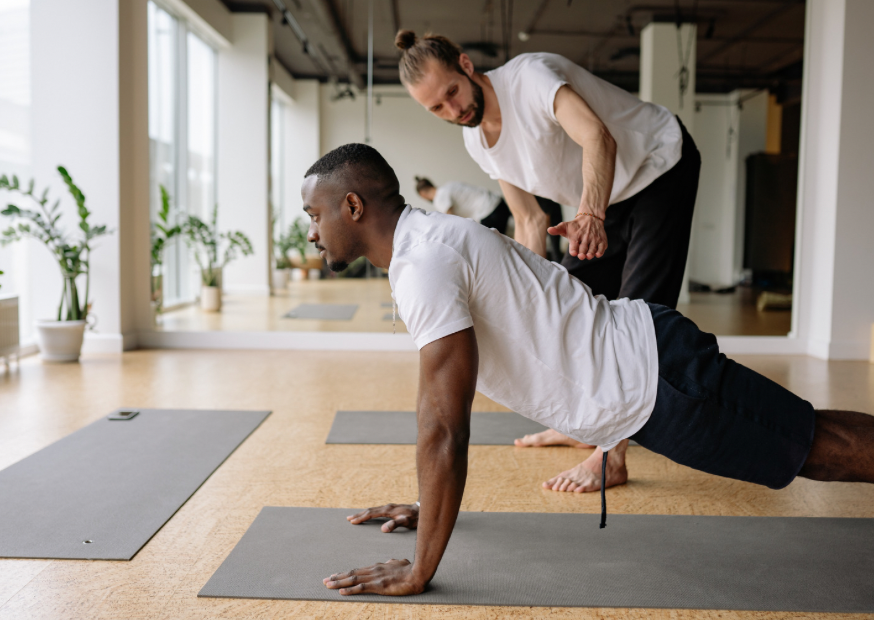
When should you return and is stretching really what your injury needs?
Sprains and strains are extremely common.
And for someone who practises yoga, the instinctive response to an injured area can sometimes be:
“It feels tight, so I need to stretch it.”
But that isn’t always what a recovering tissue needs.
Depending on the injury and stage of healing, repeatedly stretching an injured muscle, tendon or ligament may simply keep irritating it.
Recovery may instead require:
protection → movement → strength → gradual loading → return to normal activity.
Yoga can potentially become part of that process.
But it needs to match the stage of recovery.
What is the difference between a sprain and a strain?
Although the words are often used interchangeably, they aren’t quite the same.
A sprain involves a ligament — the strong connective tissue helping to stabilise a joint.
A strain involves a muscle and/or its associated tendon.
Common sprains include:
- Ankle sprains
- Knee sprains
- Wrist sprains
- Thumb sprains
Common strains can affect:
- Hamstrings
- Calves
- Back
- Groin
- Shoulders
- Other muscles
Symptoms can include pain, swelling, bruising, weakness and difficulty using or putting weight through the injured area. (nhs.uk)
What should I do immediately after an injury?
For the first two to three days following a sprain or strain, current NHS advice uses PRICE:
Protection - Protect the injured area.
Rest - Stop activities that aggravate the injury.
Ice - Use an appropriately wrapped ice pack for up to 20 minutes every two to three hours.
Compression - A suitable bandage may help support the area.
Elevation - Elevating the injured area may help manage swelling.
The NHS also advises avoiding heat, alcohol and massage during the first couple of days. (nhs.uk)
This means that immediately following a significant sprain or strain is generally not the time to stretch it out in yoga.
Movement is still important
Rest doesn’t mean complete immobility indefinitely.
The NHS advises beginning to move the injured area when pain no longer prevents movement, helping to reduce stiffness. (nhs.uk)
This is where rehabilitation gradually changes.
Initially: Protect.
Then: Move.
Then: Strengthen and load.
Eventually: Return to normal activity.
Exactly how quickly this happens depends on the injury.
Why stretching isn’t always the answer
This is particularly relevant to yoga.
An injured muscle can feel:
- Tight
- Stiff
- Short
- Restricted
But the sensation of tightness doesn’t necessarily mean the tissue needs a deeper stretch.
Sometimes it reflects:
- Protective muscle tension
- Irritation
- Weakness
- Swelling
- Reduced tolerance to load
If you repeatedly push into the sensation because you want to “release” it, you may aggravate the injury.
Instead of asking:
“How can I stretch this further?”
sometimes the better question is:
“What does this tissue need to become strong and tolerant of movement again?”
Sprains and joint stability
Ligaments help stabilise joints.
Following a sprain, particularly a significant one, the joint may temporarily have poorer stability and proprioception.
This is particularly common following ankle sprains.
That means yoga balance work can eventually be very useful.
But immediately challenging yourself with:
- Tree Pose
- Half Moon
- Warrior III
- Eyes-closed balances
may not be sensible.
Start with support.
A wall or chair allows you to train balance rather than test balance.
Returning after an ankle sprain
Ankle sprains are among the most common soft-tissue injuries.
As you recover, you may need to rebuild:
- Ankle mobility
- Calf strength
- Foot strength
- Balance
- Proprioception
- Confidence
Initially modify:
- Single-leg balances
- Deep lunges
- Fast transitions
- Large changes of direction
- Positions that create pain
Gradually progress the challenge as the ankle becomes stronger.
Returning after a knee sprain
Knee sprains vary considerably depending on which ligament is involved and the severity of the injury.
Avoid forcing:
- Deep knee flexion
- Rotation through a planted knee
- Deep lunges
- Lotus-style positions
- Movements that recreate pain or instability
A physiotherapist can advise you if a significant knee ligament has been injured.
Returning after a wrist sprain
A wrist sprain can make many yoga postures uncomfortable because yoga frequently loads the hands.
You may temporarily need alternatives to:
- Tabletop
- Plank
- Chaturanga
- Downward Dog
- Upward Dog
- Side Plank
Wall-based yoga and standing poses may allow you to remain active without placing excessive load through the wrist.
Weight-bearing can then be reintroduced gradually.
Returning after a muscle strain
Muscle strains are particularly vulnerable to the idea that “stretching will fix it”.
Imagine a hamstring strain.
A yoga practitioner may feel tightness at the back of the leg and repeatedly practise deep forward folds.
But the recovering hamstring may need progressive strengthening and loading, not repeated end-range stretching.
The same principle can apply to strains affecting the:
- Calf
- Groin
- Back
- Shoulder
Your rehabilitation programme should guide what the injured tissue needs.
Pain during yoga
Pain isn’t always a perfect indicator of tissue damage, particularly with persistent pain.
But following a recent injury, it provides useful information.
If a pose clearly recreates your injury symptoms, don’t repeatedly push further into it.
Also notice what happens after yoga.
Ask:
- Did swelling increase?
- Did pain increase later?
- Did the joint feel less stable?
- Was I significantly worse the next morning?
How your body responds afterwards can be just as useful as how it feels during the class.
How long do sprains and strains take to heal?
There isn’t one answer.
The NHS notes that many sprains and strains feel better after around two weeks, while strenuous exercise may need to be avoided for up to eight weeks. Severe injuries can take months to recover. (nhs.uk)
So:
“It has been two weeks”
isn’t automatically the same as:
“I am ready for my normal yoga practice.”
Function matters more than an arbitrary date.
What might a gradual return to yoga look like?
Stage 1 – Protect
Avoid movements that significantly load or aggravate the injury.
Stage 2 – Restore comfortable movement
Begin appropriate pain-limited movement.
Stage 3 – Rebuild strength
Introduce progressively greater load.
Stage 4 – Restore balance and control
Particularly important following joint sprains.
Stage 5 – Return to yoga-specific movements
Gradually reintroduce the positions your normal practice requires.
Stage 6 – Return to full practice
This doesn’t necessarily mean immediately returning to your deepest range or longest class.
Build progressively.
When should I get the injury checked?
Seek medical assessment if:
- Pain is severe or worsening
- Swelling or bruising is substantial or increasing
- You cannot put weight through the area
- Movement is very restricted
- It isn’t improving
- The body part looks deformed
- You have numbness or tingling
- The area becomes cold or changes colour
Some injuries that initially appear to be sprains can actually be fractures. NHS guidance recommends urgent assessment for several of these warning signs. (nhs.uk)
The Bottom Line
A sprain or strain doesn’t necessarily mean stopping yoga for months.
But yoga shouldn’t become a way of repeatedly testing an injured tissue before it is ready.
And tightness doesn’t automatically mean you need more stretching.
Sometimes what your body needs most is:
time + appropriate movement + progressive strength + gradual loading.
Yoga can eventually help rebuild mobility, balance, strength and confidence.
The key is adapting your practice to the stage of healing rather than trying to make the injured area fit your usual practice.
Frequently Asked Questions
Should I stretch a sprain?
Not simply because it feels tight. In the early stages the priority is protecting the injury. Appropriate movement can then be gradually introduced as symptoms allow. (nhs.uk)
Should I stretch a strained muscle?
Aggressive stretching isn’t necessarily helpful. A recovering muscle often needs gradual movement and progressive strengthening as part of rehabilitation.
Can I still attend yoga with an ankle sprain?
Possibly, but standing, balancing and transitions may need considerable modification. In the early stages, resting from the aggravating activity may be more appropriate.
When can I return to normal yoga?
When you have regained sufficient movement, strength and control for the demands of your practice. A severe injury may require physiotherapy and a longer rehabilitation period.
Why does an old sprain still feel unstable?
Ligament injuries can affect joint stability and proprioception. Rehabilitation may therefore need to include strength and balance rather than flexibility alone.
References
- NHS. Sprains and strains. Guidance covering symptoms, early management, return to movement, recovery and when to seek medical attention. (nhs.uk)
Topics Covered in This Article
- Yoga after a sprain
- Yoga after a muscle strain
- Difference between sprains and strains
- Early injury management
- PRICE
- Stretching an injured muscle
- Ligament injuries
- Joint stability
- Proprioception
- Ankle sprains
- Knee sprains
- Wrist sprains
- Muscle strains
- Strength and rehabilitation
- Balance after injury
- Pain during yoga
- Returning to exercise
- When to seek medical advice
- Gradually returning to yoga
Please note: This article provides general educational information and isn’t intended to diagnose an injury or replace medical or physiotherapy advice. Significant sprains and strains vary considerably and may require individual assessment and rehabilitation.

Yoga classes in Exeter, book here
My yoga classes run in themes for five weeks. This allows for people to put in place adaptions to suit their body and learn the different options of each yoga flow that are right for them. After the five weeks you will find each yoga flow published on my blog, with a free interactive copy. You will find the yoga class for this theme below.
Want to try one of my yoga classes?
I run yoga classes in Exeter- Exminster & Topsham, Devon
My Exeter based yoga classes are suitable for most levels of yogis. There are flowing sequences, often using sun salutations and vinyasa to warm the body and move through the yoga postures.
The yoga classes include an element of all styles of yoga, to bring a fresh angle to yoga and will encourage the use of yoga props in a fun and informal environment to help you explore your practice. My styles include Hatha Yoga, Vinyasa Yoga, Flow Yoga, Yin Yoga & Restorative Yoga.
Variations to yoga postures will be given throughout the class allowing each person to adapt the class to their personal level of yoga practice. All equipment is provided.
Classes are available at Kiva & Zen Studios in Topsham, Exeter, Victory Hall in Exminster, Exeter.
Book a yoga class today and immerse yourself in the tranquil atmosphere of my Exeter yoga venues, while rejuvenating your mind and body through the practice of yoga.
Each session is designed to help you connect with your inner self, cultivate mindfulness, and improve flexibility, strength, and balance. Whether you're a beginner to yoga or an experienced practitioner, there's a class for you in my Exeter venues.
As a Yoga Teacher, I underwent my initial yoga training in India and am both qualified and registered with the Yoga Alliance. Since completing my initial yoga qualification, I have undertaken further yoga studies both here in Exeter and in locations around Europe.
Book your yoga classes in Exeter