Glaucoma & Yoga: What You Need to Know
Can you still practise yoga if you have glaucoma?
Being diagnosed with glaucoma does not necessarily mean that you need to stop doing yoga.
However, glaucoma is one of those conditions where some yoga positions need more consideration than others. In particular, positions where the head is below the heart can temporarily increase pressure inside the eye, known as intraocular pressure (IOP).
The good news is that there are plenty of ways to adapt a yoga practice so that you can continue to benefit from movement, strength, balance, mobility, breathing and relaxation while taking your individual eye health into account.
This article is intended as a practical guide for people with glaucoma who would like to continue practising yoga. It is not a replacement for advice from your ophthalmologist or other eye-care professional.
What is glaucoma?
Glaucoma is a group of eye conditions in which the optic nerve, which connects the eye to the brain, becomes damaged.
It is often associated with increased pressure inside the eye, although glaucoma can also develop when eye pressure is within what is considered a normal range. This is known as normal-tension glaucoma.
Glaucoma usually develops gradually and may not cause noticeable symptoms in the early stages. This is why regular eye examinations and monitoring are important.
Treatment can include eye drops, laser treatment or surgery, depending on the type of glaucoma and the individual. The aim is to prevent or slow further damage to the optic nerve and preserve vision. (nhs.uk)
There are several types of glaucoma, including:
- Primary open-angle glaucoma
- Angle-closure glaucoma
- Normal-tension glaucoma
- Secondary glaucoma
- Childhood or congenital glaucoma
Your specific type of glaucoma matters, so it is important that your yoga practice is considered alongside the advice you have been given by your eye-care team.
Can I still do yoga if I have glaucoma?
For many people, yes.
Having glaucoma does not automatically mean that you need to give up yoga.
Instead, it is useful to think about how you practise, rather than simply whether you practise.
A yoga practice can include:
- Standing postures
- Strengthening work
- Balance exercises
- Gentle mobility
- Supported poses
- Seated practices
- Breathing exercises
- Relaxation
- Meditation
- Body awareness
The main area that requires particular attention is prolonged or deep head-down positioning.
This means that someone with glaucoma may be able to enjoy a gentle Hatha or restorative practice, for example, while modifying or avoiding certain inversions and head-down postures.
How might yoga support someone with glaucoma?
Yoga should not be considered a treatment or cure for glaucoma. However, some aspects of yoga may be useful as part of a healthy lifestyle alongside appropriate medical care.
1. Movement and general physical activity
Regular physical activity has benefits for cardiovascular health, strength, mobility, balance and general wellbeing.
Research into exercise and glaucoma has found that aerobic and resistance exercise can temporarily reduce intraocular pressure, although much of the research has looked at individual exercise sessions and more research is needed to understand the longer-term effects. (PubMed)
Yoga can contribute to overall physical activity, particularly when a practice includes standing, strengthening and balance work.
2. Strength and balance
Maintaining strength and balance becomes particularly important.
Yoga can provide opportunities to work on:
- Leg strength
- Core strength
- Postural awareness
- Balance
- Coordination
- Mobility
For someone whose vision has already been affected by glaucoma, balance and spatial awareness may become more challenging.
A yoga practice can therefore be adapted to include additional support from a wall, chair or other stable surface.
3. Breathing and relaxation
One of the gentler aspects of yoga is its emphasis on breathing and relaxation.
There is some interesting research investigating whether meditation, relaxation and breathing practices may influence intraocular pressure. A systematic review and meta-analysis found that several relaxation techniques were associated with reductions in IOP, although the evidence is still developing and the studies varied considerably. (PubMed)
A 2023 systematic review specifically looking at yoga and glaucoma also found evidence of potential reductions in IOP with some slow breathing practices, while finding that inverted postures caused rapid increases in IOP. The researchers highlighted the limitations of the available evidence and the need for larger, longer-term studies. (PubMed)
This is an interesting area of research, but it is important not to turn these findings into the message that yoga treats glaucoma.
The biggest consideration: head-down positions
If you have glaucoma, this is probably the most important part of this article.
Research has consistently found that putting the head below the level of the heart can cause a temporary rise in intraocular pressure.
A 2024 study measuring IOP during several common yoga positions found increases in both healthy participants and people with glaucoma, with the largest increases occurring in head-down positions. The pressure rose rapidly after moving into the position and returned towards baseline afterwards. (PubMed)
This doesn’t mean that every temporary increase causes damage, and the research does not establish that practising these poses necessarily causes glaucoma to progress.
However, because pressure inside the eye is an important factor in glaucoma management, it makes sense to be cautious about prolonged or repeated head-down positions.
Yoga positions that may need modifying or avoiding
Depending on your individual circumstances and the advice from your ophthalmologist, you may need to modify or avoid positions such as:
Downward-Facing Dog
Downward Dog places the head below the heart and can cause a significant temporary increase in IOP.
Instead, you could consider:
- Puppy Pose with appropriate modification
- Standing at a wall
- Hands supported on a chair
- A shorter, less head-down variation where appropriate
Standing Forward Fold
A deep standing forward fold places the head below the heart.
Instead, try:
- A gentle hip hinge
- Bent knees
- Hands supported on blocks or a chair
- Keeping the head higher rather than allowing it to hang towards the floor
Headstand
Full inversions such as Headstand create a substantial change in pressure within the head and eyes.
These are generally not appropriate to introduce casually if you have glaucoma. Discuss them with your ophthalmologist before considering them.
Shoulder Stand and Plough
These are also strong inversions and may significantly increase IOP.
They are best avoided unless you have specifically been advised that they are appropriate for you.
Legs Up the Wall
Although this is often considered a gentle and restorative posture, it still places the legs above the heart and changes the relationship between the head and the rest of the body.
Because individual circumstances differ, ask your eye-care professional whether this position is appropriate for you rather than assuming that a restorative pose is automatically suitable.
What about forward bends?
You do not necessarily need to avoid all forward movement.
There is a difference between:
A gentle forward movement with the head relatively elevated
and
A deep forward fold where the head hangs below the heart.
For example, you might practise a seated forward movement with your spine long and your head supported or elevated rather than taking the forehead towards the knees.
Blocks, bolsters, chairs and other props can be particularly useful here.
The aim is not to make yoga restrictive. It is to find a version of the movement that works for your body and your individual circumstances.
What might a glaucoma-friendly yoga practice look like?
There are many postures that can be incorporated without deliberately placing the head below the heart.
For example:
Standing postures
- Mountain Pose
- Warrior I
- Warrior II
- Modified Triangle
- Side-angle variations
- Supported standing balance work
- Chair Pose
Balance work
Balance can be practised with:
- A wall nearby
- A chair for support
- One hand lightly touching a stable surface
- A wider stance
- Reduced visual challenge where appropriate
If glaucoma has affected peripheral vision, having a clear practice space and good lighting can also be helpful.
Gentle mobility
You may be able to include:
- Gentle Cat-Cow within a comfortable range
- Seated spinal mobility
- Gentle side bends
- Shoulder and upper-back mobility
- Hip mobility
- Ankle mobility
The emphasis should be on comfortable movement rather than forcing range.
Strength
Yoga can also incorporate strengthening work such as:
- Modified Chair
- Warrior variations
- Supported lunges
- Standing leg work
- Bird Dog
- Modified plank variations where appropriate
Strength work does not have to mean an intense or fast-paced class.
Breathing: does glaucoma mean I should avoid pranayama?
Not necessarily.
Gentle, comfortable breathing practices may be appropriate and are an area of ongoing research in relation to glaucoma.
However, I would be cautious with forceful breathing techniques or prolonged breath retention, particularly if you have been advised to avoid straining or significant pressure changes.
For many people, a simple approach is enough:
- Breathe comfortably
- Avoid forcing the breath
- Avoid prolonged breath holding unless specifically advised
- Allow the breath to remain smooth and relaxed
- Stop if you feel uncomfortable
Relaxation and meditation can also be incorporated without requiring complicated breathing techniques.
What if glaucoma has affected my vision?
This is another important consideration when adapting yoga.
Glaucoma can affect peripheral vision, and some people experience changes in their ability to see clearly or navigate their environment. (nhs.uk)
If your vision has been affected, you may find it helpful to:
- Practise in a well-lit space
- Keep the floor clear of unnecessary objects
- Use a wall or chair for balance
- Avoid moving quickly between positions
- Give yourself extra time when changing direction
- Tell your teacher about your vision
- Position yourself where you can clearly hear and see instructions
- Use tactile or verbal cues rather than relying entirely on visual demonstration
There is no need to feel embarrassed about asking for these adaptations. A good teacher should be able to work with you.
Choosing the right yoga class
If you have glaucoma, the style and teaching approach of your class may be more important than the name of the style.
Look for a teacher who:
- Is happy to discuss your diagnosis
- Understands that inversions may need modifying
- Offers alternatives rather than simply telling you what you cannot do
- Encourages you to work within your own comfortable range
- Uses props
- Allows time for transitions
- Understands that not every student will have the same needs
It is always worth telling your teacher before class that you have glaucoma.
You do not need to wait until you are struggling with a particular posture.
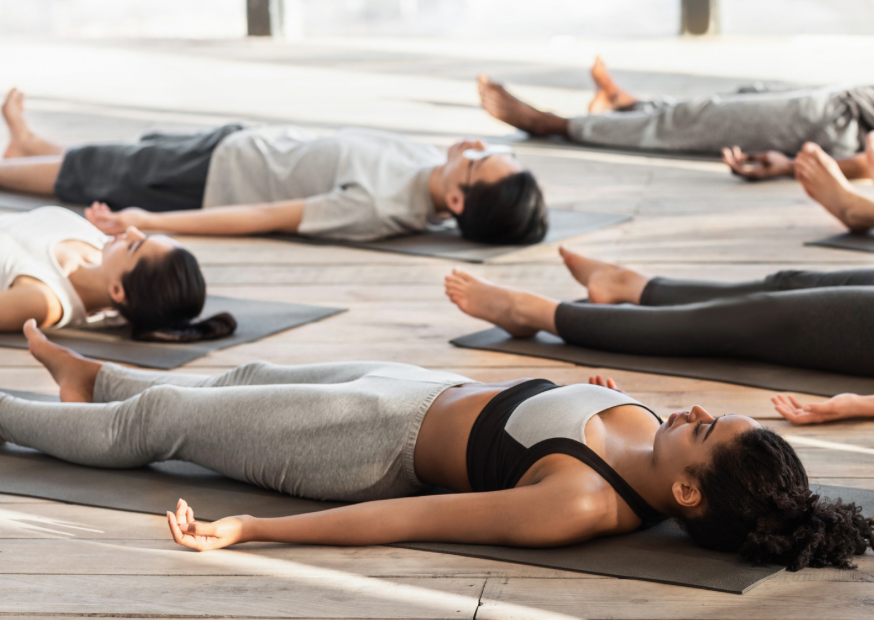
What about restorative yoga?
Restorative yoga can be a lovely option for someone who wants a slower practice focused on relaxation and supported positions.
However, restorative does not automatically mean suitable for glaucoma.
Some restorative poses, including certain versions of Legs Up the Wall or deeply supported forward folds, can still place the head in a lower position.
The same principles apply: consider the position of your head, use appropriate modifications and choose alternatives where necessary.
A restorative practice could instead focus on:
- Comfortable seated positions
- Supported reclined positions where appropriate
- Gentle mobility
- Relaxed breathing
- Body awareness
- Meditation
- Relaxation
What about nutrition and lifestyle?
Nutrition cannot cure glaucoma, and it should never be used as a replacement for prescribed treatment.
However, a generally balanced diet provides nutrients needed for overall health and supports cardiovascular and eye health.
A varied diet can include:
- Plenty of colourful vegetables and fruit
- Leafy green vegetables
- Sources of omega-3 fats
- Nuts and seeds
- Wholegrains
- Beans and pulses
- Adequate protein
- Plenty of fluids
Lifestyle factors such as regular physical activity, not smoking, maintaining cardiovascular health and attending regular eye appointments are all relevant to general health and glaucoma management.
Your ophthalmologist’s treatment plan remains the most important part of managing glaucoma.
When should I seek medical advice?
If you have glaucoma, continue with your regular eye appointments and prescribed treatment.
You should also seek urgent medical attention if you develop symptoms such as:
- Sudden severe eye pain
- A red eye
- Sudden blurred vision
- Seeing rainbow-coloured rings around lights
- Significant headache associated with eye symptoms
- Nausea or vomiting alongside sudden eye symptoms
Sudden symptoms can occur with acute angle-closure glaucoma and require urgent treatment. (nhs.uk)
Practical tips for practising yoga with glaucoma
If you have been diagnosed with glaucoma, these simple steps can help:
1. Tell your yoga teacher. They need to know that you have glaucoma so they can offer appropriate modifications.
2. Ask your ophthalmologist about inversions. Your individual diagnosis, eye pressure and treatment all matter.
3. Be cautious with prolonged head-down positions. Downward Dog, deep forward folds and full inversions can temporarily raise IOP.
4. Don’t assume that a gentle-looking pose is automatically suitable. Legs Up the Wall and some restorative positions can still change head position significantly.
5. Use props. Blocks, chairs, bolsters and walls can make many postures more accessible.
6. Avoid forcing or straining. Yoga should not involve pushing yourself into a position or holding your breath to achieve it.
7. Take transitions slowly. This is particularly important if your vision or balance has been affected.
8. Keep your practice spacious and well lit. This can make movement around the room easier if your peripheral vision is affected.
9. Continue your medical treatment. Yoga is an adjunct to glaucoma care, not a replacement for eye drops, laser treatment, surgery or monitoring where these have been recommended.
10. Remember that modification isn’t failure. You can still have a varied and enjoyable yoga practice without doing every traditional yoga posture.
Summery
A diagnosis of glaucoma does not necessarily mean giving up yoga.
There are many aspects of yoga that can still be valuable, including movement, strength, balance, mobility, breathing, relaxation and mindfulness.
The main consideration is intraocular pressure. Head-down and inverted positions can cause temporary increases in eye pressure, so positions such as Downward Dog, deep forward folds, Headstand, Shoulder Stand and Plough may need to be avoided or modified. (PubMed)
At the same time, emerging research suggests that some forms of relaxation, meditation and slow breathing may have beneficial effects on IOP. However, the evidence is still developing, and yoga should not be presented as a treatment for glaucoma. (PubMed)
The goal is not to make your yoga practice smaller because you have glaucoma.
It is to adapt your practice so that you can continue moving, strengthening, breathing and relaxing in a way that respects your individual eye health.
If you have recently been diagnosed with glaucoma, talk to your ophthalmologist about any activities or positions you are unsure about, and let your yoga teacher know about your diagnosis.
Topics Covered in This Article
- What glaucoma is
- The different types of glaucoma
- Whether you can practise yoga with glaucoma
- How yoga may support general health and wellbeing
- Yoga, exercise and intraocular pressure
- Breathing, relaxation and meditation
- Why head-down positions need consideration
- Yoga positions that may need modifying or avoiding
- Downward Dog and glaucoma
- Forward folds and glaucoma
- Inversions and glaucoma
- How to adapt a yoga practice
- Balance and vision changes
- Restorative yoga and glaucoma
- Breathing practices and pranayama
- Nutrition and lifestyle considerations
- Choosing a suitable yoga class
- Practical safety tips
- When to seek urgent medical advice
Frequently Asked Questions
Can I do yoga if I have glaucoma?
For many people, yes. You may simply need to modify certain positions, particularly deep head-down positions and inversions.
Should I avoid Downward Dog if I have glaucoma?
Downward Dog can cause a temporary increase in intraocular pressure because the head is below the heart. It is therefore sensible to discuss this posture with your ophthalmologist and consider alternatives or modifications.
Can I do yoga inversions with glaucoma?
Full inversions such as Headstand and Shoulder Stand can cause substantial temporary increases in IOP. They should not be assumed to be suitable simply because you have previously practised them. Discuss them with your eye-care professional.
Can yoga cure glaucoma?
No. There is currently no cure for glaucoma, although treatment can slow or prevent further vision loss. Yoga should be considered an adjunct to appropriate medical care rather than a treatment or replacement for prescribed treatment. (nhs.uk)
Can breathing exercises help glaucoma?
There is emerging evidence that some slow breathing, meditation and relaxation techniques may reduce IOP, but research is still developing. They should be viewed as complementary practices rather than a treatment for glaucoma. (PubMed)
Is restorative yoga suitable if I have glaucoma?
It can be, but the individual positions still matter. Some restorative poses place the head below the heart, so these may need to be modified.
Do I need to tell my yoga teacher that I have glaucoma?
Yes. This allows your teacher to understand your needs and offer alternatives to positions that may not be appropriate for you.
Can I still practise yoga if glaucoma has affected my vision?
Often, yes. You may benefit from a clear, well-lit practice space, additional support for balance and more verbal instruction. Your practice can be adapted to your level of vision.
References
- NHS. Glaucoma. NHS website. (nhs.uk)
- Moorfields Eye Hospital. Glaucoma – Diagnosis and Treatment. (Moorfields Eye Hospital)
- Moorfields Eye Hospital. Glaucoma. (Moorfields Eye Hospital)
- Chetry D, Singh J, Chhetri A, Katiyar VK, Singh DS. Effect of yoga on intra-ocular pressure in patients with glaucoma: A systematic review and meta-analysis. Indian Journal of Ophthalmology. 2023;71(5):1757–1765. (PubMed)
- González-Devesa D, Suárez-Iglesias D, Diz JC, Esmerode-Iglesias A, Ayán C. Systematic review on the impact of exercise on intraocular pressure in glaucoma patients. International Ophthalmology. 2024;44:351. (PubMed)
- Zaher O, Kuchtaruk AA, McGinnis ES, Paunic M, Malvankar-Mehta M. Effect of various relaxation techniques on the intraocular pressure of patients with glaucoma: systematic review and meta-analysis. Canadian Journal of Ophthalmology. 2024;59(4):e343–e349. (PubMed)
- Shajiei TD, Wachtl J, Schuknecht A, Bachmann L, Kniestedt C. The Effect of Yoga on Intraocular Pressure Using the “iCare HOME2” Tonometer. Klinische Monatsblätter für Augenheilkunde. 2024;241(4):347–354. (PubMed)
- Zhou W, Fricke L, Sabel BA. Eye yoga for glaucoma: recovery of vascular dysregulation and visual field function – a randomized controlled trial. EPMA Journal. 2025;16:37–49. (PubMed)
Please note: This article is for general educational purposes and is not intended to diagnose, treat or replace individual medical advice. If you have glaucoma, particularly if you have recently been diagnosed or have had eye surgery, speak to your ophthalmologist or eye-care professional about any activities or yoga positions you are unsure about.
Yoga classes in Exeter, book here
My yoga classes run in themes for five weeks. This allows for people to put in place adaptions to suit their body and learn the different options of each yoga flow that are right for them. After the five weeks you will find each yoga flow published on my blog, with a free interactive copy. You will find the yoga class for this theme below.
Want to try one of my yoga classes?
I run yoga classes in Exeter- Exminster & Topsham, Devon
My Exeter based yoga classes are suitable for most levels of yogis. There are flowing sequences, often using sun salutations and vinyasa to warm the body and move through the yoga postures.
The yoga classes include an element of all styles of yoga, to bring a fresh angle to yoga and will encourage the use of yoga props in a fun and informal environment to help you explore your practice. My styles include Hatha Yoga, Vinyasa Yoga, Flow Yoga, Yin Yoga & Restorative Yoga.
Variations to yoga postures will be given throughout the class allowing each person to adapt the class to their personal level of yoga practice. All equipment is provided.
Classes are available at Kiva & Zen Studios in Topsham, Exeter, Victory Hall in Exminster, Exeter.
Book a yoga class today and immerse yourself in the tranquil atmosphere of my Exeter yoga venues, while rejuvenating your mind and body through the practice of yoga.
Each session is designed to help you connect with your inner self, cultivate mindfulness, and improve flexibility, strength, and balance. Whether you're a beginner to yoga or an experienced practitioner, there's a class for you in my Exeter venues.
As a Yoga Teacher, I underwent my initial yoga training in India and am both qualified and registered with the Yoga Alliance. Since completing my initial yoga qualification, I have undertaken further yoga studies both here in Exeter and in locations around Europe.
Book your yoga classes in Exeter