Practising yoga with high or low blood pressure
If you’ve been told that you have high or low blood pressure, you may be wondering whether you can continue practising yoga.
For many people, the answer is yes.
However, high blood pressure (hypertension) and low blood pressure (hypotension) present different considerations during exercise.
If your blood pressure is high, we need to think about things such as exercise intensity, straining, breath-holding and certain demanding postures.
If your blood pressure is low, the bigger concern may be dizziness, light-headedness or fainting, particularly when changing position quickly or getting up from the floor.
And some people can experience both. For example, someone being treated for hypertension may occasionally experience low blood pressure or postural hypotension.
Understanding these differences can help you adapt your yoga practice without necessarily giving it up.
What is blood pressure?
Blood pressure is the force of your blood pushing against the walls of your arteries as your heart pumps blood around your body.
A blood pressure reading contains two numbers.
For example:
120/80 mmHg
The first number is your systolic blood pressure — the pressure when your heart contracts and pumps blood.
The second is your diastolic blood pressure — the pressure when your heart relaxes between beats.
Blood pressure naturally changes throughout the day depending on factors such as:
- Physical activity
- Stress
- Hydration
- Temperature
- Medication
- Illness
- Body position
One unusual reading therefore doesn’t necessarily mean that you have a blood-pressure condition.
What is high blood pressure?
High blood pressure is also known as hypertension. In the UK, blood pressure is usually considered high when readings are consistently:
- 140/90 mmHg or higher when measured by a healthcare professional
- 135/85 mmHg or higher when measured at home
High blood pressure often causes no symptoms, which is why having it measured is important.
If it remains high over time, it places additional strain on the blood vessels, heart and other organs and increases the risk of conditions including heart disease, heart attack and stroke. Lifestyle changes and, when necessary, medication can help manage it.
What is low blood pressure?
Low blood pressure is also known as hypotension.The NHS defines low blood pressure as a reading below:
90/60 mmHg
However, having naturally low blood pressure isn’t necessarily a problem.
Some people have relatively low readings and feel completely well. Low blood pressure becomes more relevant when it causes symptoms such as:
- Dizziness
- Light-headedness
- Blurred vision
- Weakness
- Feeling sick
- Confusion
- Fainting
If these symptoms occur when you stand up or suddenly change position, you may have postural or orthostatic hypotension.
That becomes particularly relevant during yoga because we regularly move between lying, seated and standing positions.
Can I still do yoga if I have high or low blood pressure?
For many people, yes.
But how you practise may need to change.
Yoga can include:
- Gentle movement
- Strength
- Mobility
- Balance
- Breathing
- Relaxation
- Meditation
- Body awareness
These can all form part of a healthy, active lifestyle. The important thing is understanding which elements of a yoga practice may need modifying for your particular blood pressure.
Yoga and HIGH blood pressure
How might yoga help?
Regular physical activity is an important part of managing high blood pressure.
Aerobic exercise is particularly beneficial, and NHS guidance recommends aiming for at least 150 minutes of exercise each week as part of a healthy lifestyle.
Yoga shouldn’t necessarily replace activities such as:
- Walking
- Swimming
- Cycling
- Other aerobic exercise
- Appropriate resistance training
But it can complement them.
Research investigating yoga in people with hypertension has found potentially beneficial effects on blood pressure.
A 2025 systematic review and meta-analysis of 30 randomised controlled trials involving 2,283 participants found reductions in systolic and diastolic blood pressure compared with waiting-list controls.
However, the researchers rated the certainty of this evidence as very low, so yoga should be considered a complementary activity rather than a treatment for hypertension.
Breathing and relaxation
One potentially useful part of yoga is the combination of movement, breathing and relaxation.
Stress can cause temporary increases in heart rate and blood pressure.
Slow breathing and relaxation may help encourage a calmer physiological state.
This doesn’t mean that stress is the sole cause of hypertension, or that relaxation can replace treatment.
But breathing, relaxation and meditation can be useful additions to an overall approach to wellbeing.
The main considerations with HIGH blood pressure
If you have hypertension, the aim isn’t to be frightened of exercise.
Regular exercise is generally beneficial.
Instead, there are a few things worth considering.
Avoid holding your breath during effort
This is particularly important.
When something feels physically difficult, it is easy to unconsciously hold your breath.
This can happen during:
- Plank
- Chair Pose
- Strong standing poses
- Balances
- Core exercises
- Long holds
Breath-holding while straining can cause blood pressure to rise.
Instead:
Keep breathing throughout the movement.
If you cannot comfortably breathe while holding a posture, reduce the intensity or come out of the pose.
Be sensible about intensity
Yoga can range from extremely gentle to very physically demanding.
A slow Hatha class is very different from:
- Fast-paced Vinyasa
- Power yoga
- Long strenuous holds
- Heated yoga
- Advanced arm balances
If your hypertension isn’t well controlled, or you’ve recently been diagnosed, ask your healthcare professional what level of exercise intensity is appropriate for you.
What about inversions and high blood pressure?
This is one of the most common questions.
Traditional yoga inversions can include:
- Headstand
- Shoulder Stand
- Handstand
- Forearm Stand
These positions create significant cardiovascular changes and are not an appropriate starting point for someone with uncontrolled high blood pressure.
If you have hypertension and want to practise strong inversions, discuss this with the healthcare professional managing your condition rather than assuming they are suitable. You certainly don’t need inversions to have a complete yoga practice.
Yoga and LOW blood pressure
Low blood pressure presents a different challenge.
If your blood pressure is naturally low but you don’t experience any symptoms, it may have very little effect on your yoga practice.
However, if you experience dizziness or fainting, your practice needs more consideration.
The biggest consideration with LOW blood pressure: changing position
Yoga involves a lot of changes in body position.
For example:
Lying → sitting → kneeling → standing
or:
Forward fold → standing
For someone with postural hypotension, blood pressure can fall when standing up.
This can cause:
- Dizziness
- Light-headedness
- Blurred vision
- Weakness
- Unsteadiness
- Fainting
The NHS specifically recommends moving slowly from lying to sitting and from sitting to standing if you experience low blood pressure.
So in yoga:
There is absolutely no need to get up at the same speed as everyone else.
How to change position safely
Instead of moving directly from lying to standing, try:
Lie → roll onto your side → sit → pause → kneel or stand slowly
Take a few breaths at each stage if necessary.
If you’ve been lying in Savasana for several minutes, particularly after a relaxing practice, give your circulation time to adjust before standing.
Forward folds and low blood pressure
If you experience postural hypotension, quickly coming from a deep forward fold into standing can cause dizziness.
Rather than:
Forward Fold → immediately standing upright
try:
Forward Fold → Half Lift → pause → bend the knees → gradually rise
You can also:
- Keep the forward fold shallower
- Use blocks
- Place your hands on a chair
- Take additional time
- Sit down if you feel dizzy
Never try to “push through” dizziness.
What about Downward-Facing Dog?
For many people with blood-pressure conditions, Downward Dog isn’t automatically contraindicated.
However, it does involve the head being lower than the heart and is followed in many yoga sequences by a significant change in position.
Someone with low blood pressure may particularly notice symptoms when coming out of the pose.
Move slowly and notice how you respond.
If you repeatedly feel dizzy, choose an alternative such as working with your hands against a wall or chair.
Hot yoga and blood pressure
Heat causes blood vessels to dilate and increases fluid loss through sweating.
For someone prone to low blood pressure, this can potentially make dizziness and light-headedness more likely, particularly if dehydration develops.
Hot yoga can also place greater cardiovascular demands on the body.
If you have hypertension, symptomatic hypotension, heart disease or another cardiovascular condition, discuss heated exercise with your healthcare professional before participating.
A normal-temperature yoga environment is generally much easier to control.
Hydration and low blood pressure
Hydration is particularly important if you are prone to low blood pressure.
The NHS recommends increasing water intake as one of the measures that may help people experiencing symptoms of hypotension.
Make sure you are adequately hydrated before class, particularly:
- In warm weather
- After illness
- If you’ve been sweating
- During longer exercise sessions
If your doctor has advised you to restrict fluids because of another medical condition, follow their advice instead.
Blood-pressure medication and yoga
Medication is another reason that someone’s experience may not fit neatly into either “high” or “low” blood pressure.
Someone may have hypertension but take medication that lowers their blood pressure enough to occasionally cause:
- Dizziness
- Light-headedness
- Weakness
- Postural hypotension
The British Heart Foundation notes that some medications affecting blood pressure can make people more susceptible to dizziness when moving quickly between lying, sitting and standing.
If you’ve recently started or changed blood-pressure medication and notice new dizziness or faintness, speak to your GP or prescribing healthcare professional.
Do not stop prescribed blood-pressure medication because of something you experience during yoga without discussing it with them first.
What about breathing exercises?
Breathing can be a lovely part of yoga for people with blood-pressure conditions.
Gentle practices might include:
- Relaxed diaphragmatic breathing
- Slow comfortable breathing
- Extending the exhalation gently
- Breath awareness
- Meditation combined with natural breathing
The emphasis should be on comfortable breathing rather than forcing the breath.
For someone with hypertension, I would generally avoid encouraging prolonged or forceful breath retention during strenuous postures.
For someone prone to dizziness, forceful breathing techniques may also feel unpleasant.
You don’t need complicated pranayama to benefit from paying attention to your breath.
What might a blood-pressure-friendly yoga practice look like?
Depending on the individual, you might include:
Standing postures
- Mountain Pose
- Warrior I
- Warrior II
- Supported Triangle
- Chair Pose
- Side Angle
- Gentle standing mobility
Balance
- Supported Tree Pose
- Heel raises
- Weight transfers
- Supported single-leg balance
Strength
- Controlled Chair Pose
- Supported lunges
- Bridge
- Bird Dog
- Gentle core work
- Modified Plank where appropriate
Mobility
- Gentle Cat-Cow
- Shoulder mobility
- Hip mobility
- Seated spinal movements
- Gentle side bends
Relaxation
- Supported rest
- Savasana
- Meditation
- Body scanning
- Comfortable breathing practices
The appropriate practice depends on your diagnosis, symptoms, medication and general health.
Restorative yoga and blood pressure
Restorative yoga can be particularly useful for slowing down and encouraging relaxation.
However, if you have low blood pressure, remember that the transition out of a restorative pose matters.
After lying still for several minutes:
- Roll onto your side
- Pause
- Come slowly to sitting
- Remain seated for a few breaths
- Stand gradually
If you feel dizzy, stay seated or lie back down.
Choosing the right yoga class
If you have a blood-pressure condition, look for a teacher who:
- Is happy to offer modifications
- Allows you to work at your own pace
- Doesn’t encourage excessive straining
- Reminds students to breathe
- Allows slow transitions
- Uses props
- Is comfortable offering alternatives to inversions
- Doesn’t expect everyone to perform every posture
Tell your teacher about your blood-pressure condition before class.
It is particularly important to mention:
- Uncontrolled hypertension
- Episodes of dizziness
- Fainting
- Postural hypotension
- Recent changes to blood-pressure medication
- Heart or circulatory conditions
When should I stop?
Stop exercising if you feel:
- Faint
- Significantly dizzy
- Unusually breathless
- Unwell
- New or significant palpitations
- Chest pain
Sit or lie somewhere safe rather than trying to continue with the class.
Seek appropriate medical advice depending on the symptoms and their severity.
Practical tips for yoga with HIGH blood pressure
1. Keep breathing.
Avoid holding your breath while working hard.
2. Don’t strain to achieve a pose.
Reduce the intensity if necessary.
3. Build exercise gradually.
You don’t need to start with a demanding practice.
4. Be cautious with strong inversions.
Particularly if your blood pressure isn’t well controlled.
5. Include relaxation.
Gentle breathing and relaxation can complement an active lifestyle.
6. Keep doing cardiovascular exercise.
Yoga can complement walking, swimming, cycling and other appropriate aerobic activity rather than necessarily replacing it.
7. Continue your prescribed treatment.
Yoga isn’t a substitute for medication or medical monitoring.
Practical tips for yoga with LOW blood pressure
1. Change position slowly.
This is probably the most important adaptation.
2. Pause before standing.
Give your circulation time to adjust.
3. Be particularly careful after Savasana.
4. Come out of forward folds gradually.
5. Stay appropriately hydrated.
6. Be cautious with excessive heat.
7. Use a wall or chair if dizziness affects your balance.
8. Sit or lie down if you feel faint.
9. Tell your teacher.
10. Seek medical advice if dizziness or fainting is recurring.
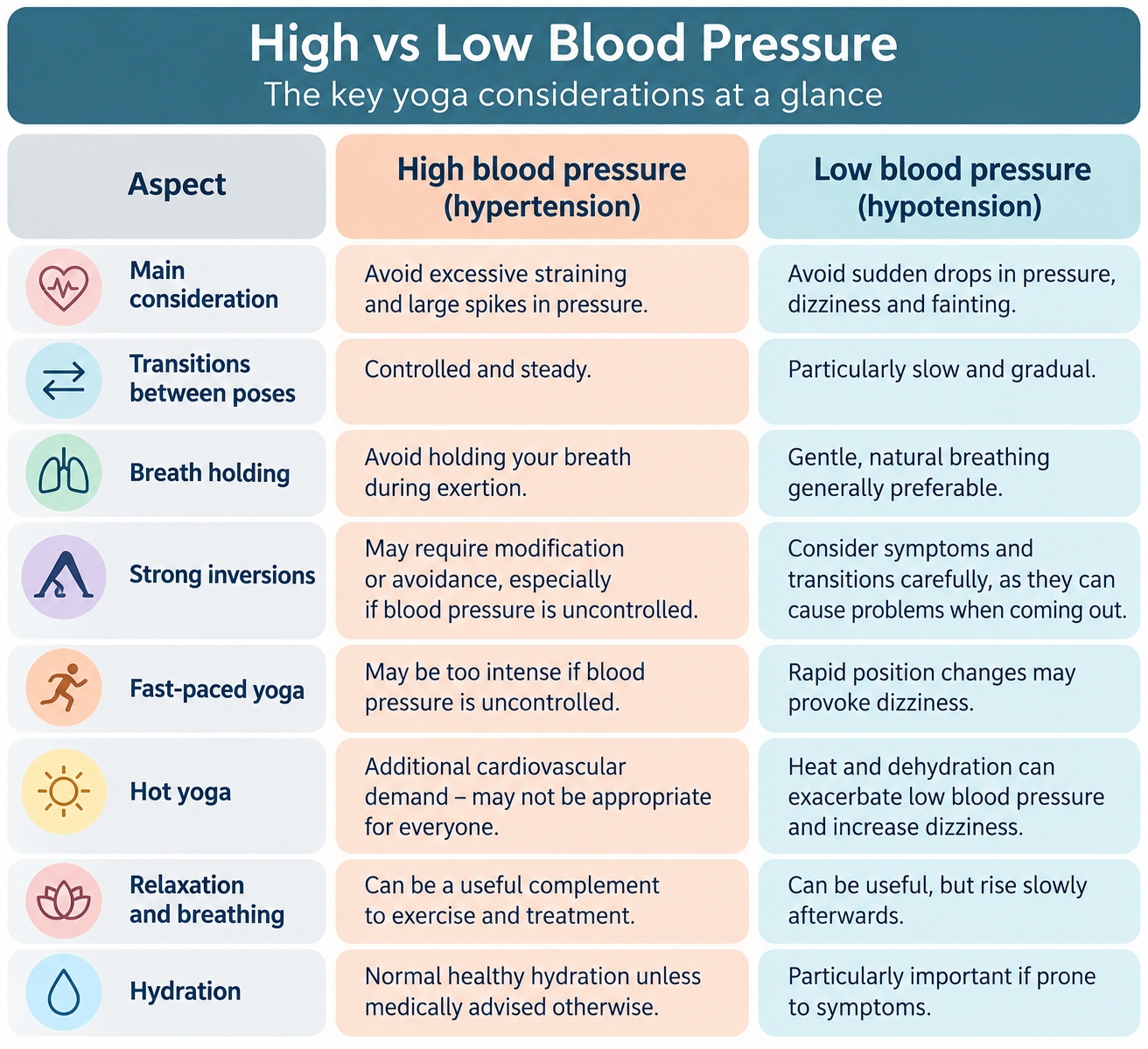
High vs Low Blood Pressure: The Yoga Considerations
Summery
Having high or low blood pressure doesn’t necessarily mean you need to stop practising yoga.
But the adaptations you need may be very different.
With high blood pressure, the focus is generally on:
Breathing, avoiding excessive strain, appropriate exercise intensity and being sensible about strong inversions.
With low blood pressure, the focus is more often on:
Slow transitions, hydration, managing dizziness and allowing the body time to adjust when changing position.
Yoga may also offer benefits through movement, strength, balance, breathing and relaxation.
Research suggests yoga may contribute to reductions in blood pressure in people with hypertension, but the evidence is variable and yoga should be considered part of a broader healthy lifestyle rather than a replacement for established treatment.
Most importantly, your diagnosis doesn’t need to define your entire yoga practice.
It gives you information that can help you adapt the practice to work better for your body.
Frequently Asked Questions
Can I do yoga if I have high blood pressure?
For many people, yes. Regular physical activity is recommended as part of managing hypertension. However, exercise intensity, strong inversions, straining and breath-holding may require additional consideration, particularly if your blood pressure isn’t well controlled.
Can yoga lower blood pressure?
Research suggests yoga may produce modest reductions in blood pressure in some people with hypertension. However, the quality of the evidence varies. Yoga should complement rather than replace appropriate exercise, lifestyle measures and prescribed medication.
Can I do yoga if I have low blood pressure?
Often, yes. If your low blood pressure doesn’t cause symptoms, it may have little impact on your practice. If you experience dizziness or fainting, slow changes of position become particularly important.
Why do I get dizzy when I stand up during yoga?
Your blood pressure may temporarily fall when you move from lying or sitting to standing. This is known as postural or orthostatic hypotension. Moving more slowly and pausing between positions may help.
Should I avoid Downward Dog if I have high blood pressure?
Not everyone with well-controlled hypertension needs to avoid Downward Dog. However, individual circumstances matter, particularly if your blood pressure is very high or uncontrolled or you have other cardiovascular conditions. Discuss concerns with the healthcare professional managing your blood pressure.
Should I avoid Headstand if I have high blood pressure?
Strong inversions such as Headstand are not an appropriate place to start if you have uncontrolled hypertension. If you already practise inversions and have hypertension, ask your healthcare professional whether they are appropriate for you.
Can I practise yoga while taking blood-pressure medication?
Usually, but some medications can contribute to dizziness or postural hypotension. If you develop new symptoms after starting or changing medication, speak to your GP or prescriber.
Is hot yoga suitable if I have low blood pressure?
Heat and dehydration can potentially make symptoms such as dizziness and light-headedness worse. If you have symptomatic hypotension, a normal-temperature yoga practice may be more appropriate.
Should I tell my yoga teacher about my blood pressure?
Yes. Knowing about high blood pressure, low blood pressure, dizziness, fainting or relevant medication allows your teacher to offer appropriate modifications.
References
- NHS. High blood pressure (hypertension). NHS guidance on diagnosis, risks, lifestyle and treatment.
- NHS. Low blood pressure (hypotension). NHS guidance on symptoms, postural hypotension and management.
- NHS. Blood pressure test. Guidance on blood-pressure measurement and interpretation.
- British Heart Foundation. Best exercises for heart health. Guidance on aerobic exercise, resistance training, balance, flexibility, breathing and position changes.
- British Heart Foundation. Staying Active. Guidance on physical activity and cardiovascular health.
- British Heart Foundation. Breathing exercises to relieve stress. Information on breathing, relaxation, heart rate and blood pressure.
- British Heart Foundation. How to lower your blood pressure naturally. Lifestyle and physical-activity guidance.
- Cramer H et al. A systematic review and meta-analysis of yoga for arterial hypertension. 2025. Thirty randomised controlled trials involving 2,283 participants were included. The review found reductions in systolic and diastolic blood pressure compared with waiting-list controls, although the certainty of the evidence was rated very low.
- Yoga and hypertension: a systematic review. Review of clinical research investigating yoga as an adjunct intervention for hypertension.
Topics Covered in This Article
- What blood pressure is
- Systolic and diastolic blood pressure
- High blood pressure (hypertension)
- Low blood pressure (hypotension)
- Postural or orthostatic hypotension
- Whether you can practise yoga with high blood pressure
- Whether you can practise yoga with low blood pressure
- How yoga may support cardiovascular health
- Yoga and hypertension research
- Exercise and blood pressure
- Breath-holding and blood pressure
- Breathing and relaxation
- Inversions and high blood pressure
- Downward-Facing Dog
- Forward folds and dizziness
- Getting up and down safely
- Hot yoga and blood pressure
- Hydration
- Blood-pressure medication
- Restorative yoga
- Choosing an appropriate yoga class
- Practical modifications for high blood pressure
- Practical modifications for low blood pressure
- When to stop exercising and seek advice
Please note: This article is for general educational purposes and isn’t intended to diagnose or treat high or low blood pressure or replace individual medical advice. Blood-pressure conditions vary considerably between individuals. If you have uncontrolled hypertension, recurrent dizziness or fainting, a heart or circulatory condition, or have recently changed blood-pressure medication, speak to an appropriate healthcare professional about exercise that is suitable for you.
Yoga classes in Exeter, book here
My yoga classes run in themes for five weeks. This allows for people to put in place adaptions to suit their body and learn the different options of each yoga flow that are right for them. After the five weeks you will find each yoga flow published on my blog, with a free interactive copy. You will find the yoga class for this theme below.
Want to try one of my yoga classes?
I run yoga classes in Exeter- Exminster & Topsham, Devon
My Exeter based yoga classes are suitable for most levels of yogis. There are flowing sequences, often using sun salutations and vinyasa to warm the body and move through the yoga postures.
The yoga classes include an element of all styles of yoga, to bring a fresh angle to yoga and will encourage the use of yoga props in a fun and informal environment to help you explore your practice. My styles include Hatha Yoga, Vinyasa Yoga, Flow Yoga, Yin Yoga & Restorative Yoga.
Variations to yoga postures will be given throughout the class allowing each person to adapt the class to their personal level of yoga practice. All equipment is provided.
Classes are available at Kiva & Zen Studios in Topsham, Exeter, Victory Hall in Exminster, Exeter.
Book a yoga class today and immerse yourself in the tranquil atmosphere of my Exeter yoga venues, while rejuvenating your mind and body through the practice of yoga.
Each session is designed to help you connect with your inner self, cultivate mindfulness, and improve flexibility, strength, and balance. Whether you're a beginner to yoga or an experienced practitioner, there's a class for you in my Exeter venues.
As a Yoga Teacher, I underwent my initial yoga training in India and am both qualified and registered with the Yoga Alliance. Since completing my initial yoga qualification, I have undertaken further yoga studies both here in Exeter and in locations around Europe.
Book your yoga classes in Exeter